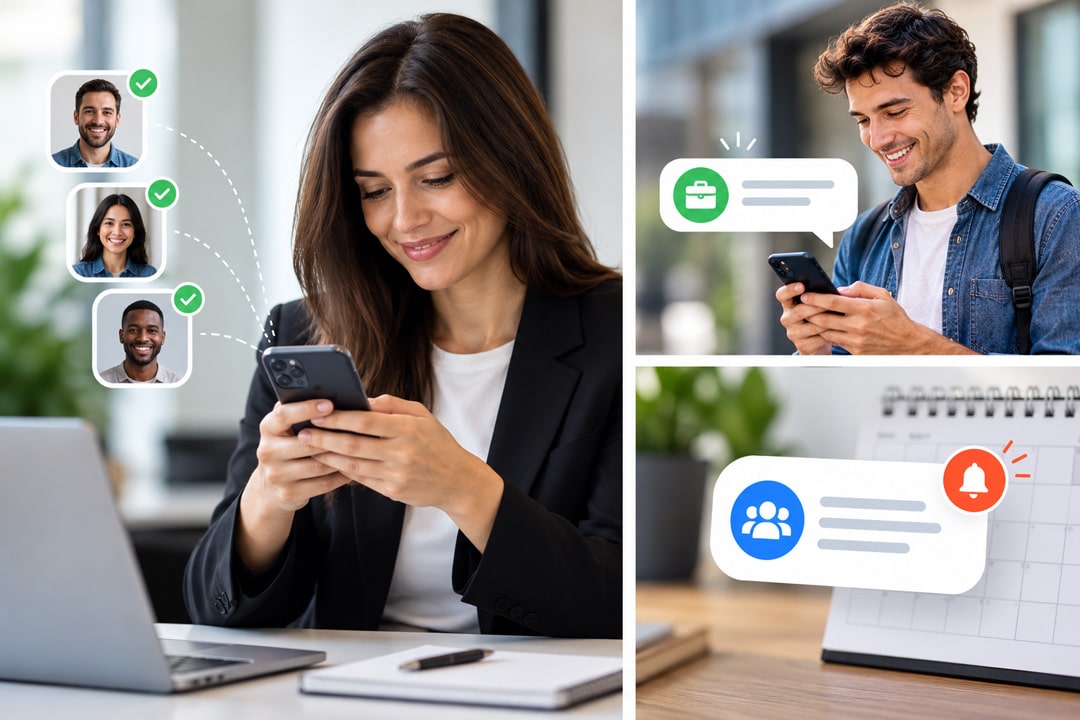
SMS gives businesses direct access to customers, but pressing “send” does not guarantee visibility. A message may fail to reach the phone, arrive at the wrong time, come from an unfamiliar number, or disappear among other notifications. Even when customers see it, unclear wording may stop them from taking action.
Therefore, better SMS visibility requires more than increasing campaign frequency. Businesses must improve deliverability, sender recognition, timing, targeting, message structure, and measurement.
The goal is not simply to place more texts in front of subscribers. Instead, marketers should make every message easier to receive, recognize, understand, and act on.
Understand What SMS Visibility Includes
SMS visibility starts with delivery, but it does not end there. A visible campaign must pass through several stages:
- The carrier accepts and delivers the message.
- The recipient recognizes the sender.
- The opening line earns attention.
- The content communicates immediate value.
- The call to action feels clear and trustworthy.
- The customer completes the intended action.
A high delivery rate only confirms that messages reached their destinations. It does not show whether subscribers noticed, trusted, or acted on them.
Consequently, businesses should examine delivery, clicks, replies, conversions, and opt-outs together. This broader view reveals whether campaigns achieve genuine visibility or merely produce delivered-message records.
Build a Permission-Based List
Visibility begins with audience quality. Customers who knowingly requested messages will more likely recognize and engage with them than people who did not expect to receive texts.
Therefore, every sign-up invitation should clearly identify the business and explain what the subscriber will receive. It should also communicate expected message frequency and provide access to relevant terms.
Strong Opt-in Sources Include:
- Checkout and account pages
- Loyalty program enrollment
- Booking forms
- Website preference centers
- In-store QR codes
- Email campaigns
- Events and printed materials
- Text-to-join keywords
However, businesses should not add phone numbers collected for unrelated purposes to promotional campaigns. CTIA guidance emphasizes obtaining appropriate consent before sending business messages and providing customers with a way to stop future texts.
Permission improves more than compliance. It also improves recognition because subscribers understand why the business is contacting them.
Make the Sender Easy to Recognize
Customers may ignore or delete messages from unfamiliar numbers. Therefore, identify the business near the beginning of each text.
Compare these examples:
- “Your offer expires at midnight. Shop now: [link]”
- “Oak Street Market: Your subscriber offer expires at midnight. Shop now: [link]”
The second message gives the recipient immediate context. Moreover, consistent sender identity helps customers connect future texts with the same business.
Companies should also select sender types that fit their locations, use cases, and volume. Messaging platforms may choose among long codes, short codes, alphanumeric sender IDs, and other available sender types according to geography and regulatory requirements.
Whenever possible, businesses should avoid changing numbers unnecessarily. A consistent sender supports familiarity and makes ongoing conversations easier to follow.
Improve the First Line
Phone notifications often display only the beginning of a message. Consequently, the first few words play a major role in visibility.
Start with the sender name and the most useful information. Avoid opening with generic phrases such as “Exciting news,” “Attention valued customer,” or “You won’t believe this.”
Instead, Let’s Write:
- “Northside Dental: Your appointment is tomorrow at 10 a.m.”
- “Marlow Shoes: The size you requested is back in stock.”
- “City Gym: Two spaces opened in tonight’s class.”
- “Oak Market: Your pickup order is ready.”
These openings explain why the recipient should continue reading. Additionally, they place the central value before links, disclaimers, or secondary details.

Keep Each Message Focused
SMS works best when one message communicates one purpose. If a text includes a sale, event invitation, loyalty update, product launch, and survey, customers may not know what to do first.
Therefore, use one primary call to action.
| Campaign Goal | Clear Action |
|---|---|
| Abandoned cart | Complete the order |
| Appointment reminder | Confirm or reschedule |
| Product restock | View the available item |
| Event promotion | Reserve a place |
| Delivery update | Track the package |
| Feedback request | Complete a short survey |
Additionally, use direct verbs such as “confirm,” “book,” “track,” “shop,” or “reply.” Clear instructions reduce the mental effort required to respond.
However, short does not mean vague. Include enough detail for customers to understand the message without guessing.
Send Texts at Useful Times
A well-written message can remain invisible when it arrives during sleep, work, travel, or another inconvenient period.
Therefore, schedule texts according to the recipient’s local time rather than the company’s office time. Also, match the delivery window to the campaign.
For example, a lunch promotion should arrive before customers make lunch plans. Meanwhile, an appointment reminder may work best one or two days before the appointment, followed by a shorter same-day confirmation when appropriate.
Businesses should also review engagement by hour and day. However, predicted engagement should never override quiet hours, consent terms, or local messaging requirements.
Most importantly, avoid assuming that the same time works for every segment. Parents, office workers, night-shift employees, and international customers may follow different routines.
Segment Campaigns for Greater Relevance
Subscribers notice messages that connect to their needs. Therefore, segmentation can improve visibility without increasing total send volume.
Useful SMS segments include:
- Recent purchasers
- First-time customers
- Loyal or high-value buyers
- Customers near a physical location
- Subscribers interested in a specific category
- Customers with abandoned carts
- People waiting for an item to return
- Inactive subscribers
- Customers approaching a renewal date
Exclusions matter as well. Remove people who already completed the action, recently purchased the advertised item, reported a service issue, or received a similar message.
As a result, fewer subscribers receive irrelevant texts, while the remaining audience has a stronger reason to pay attention.
Use Links Customers Can Trust
Long links take up valuable space and can make messages difficult to scan. Nevertheless, unknown public link shorteners may look suspicious and can create filtering or deliverability concerns.
Instead, use a branded link domain that customers can associate with the business. Some messaging services support branded link shortening and click tracking, allowing companies to reduce link length while preserving recognizable brand information.
For example, a link such as go.oakmarket.com/abc123 may inspire more confidence than an unfamiliar string from a public shortening service.
Additionally, confirm that every link opens quickly, works on mobile devices, and leads directly to the promised content. A slow or confusing landing page wastes the visibility gained through the message.
Encourage Replies and Interaction
Visibility improves when SMS becomes a conversation instead of a sequence of broadcasts.
Businesses can encourage simple replies:
- “Reply C to confirm.”
- “Reply SIZE for help choosing.”
- “Reply 1 for offers or 2 for event alerts.”
- “Have a question? Reply to this message.”
Replies give marketers another engagement signal beyond clicks. Moreover, they allow customers to complete actions without opening a browser.
However, businesses should only invite replies when someone or an appropriate automated system can handle them. An unanswered customer question can damage trust more than a one-way message.

Monitor Deliverability and Engagement
Regular monitoring helps teams identify sudden declines in visibility. Messaging dashboards can break performance down by carrier, country, sender, error code, and delivery status, which helps businesses investigate problems and establish normal delivery baselines.
Track metrics such as:
- Delivery rate
- Failure rate and error codes
- Unique click rate
- Reply rate
- Conversion rate
- Revenue per recipient
- Opt-out rate
- Complaint rate
- Performance by carrier and location
Additionally, tag campaign links with consistent UTM parameters. Google Analytics supports campaign URL tagging so marketers can identify which sources and campaigns referred website traffic.
Ultimately, better SMS visibility does not come from sending more frequently. It comes from sending expected, recognizable, useful messages to carefully selected subscribers.
When businesses combine permission, clear sender identification, relevant timing, focused copy, trusted links, and continuous measurement, each text has a stronger chance of being noticed. Consequently, SMS can deliver better engagement while creating less noise for customers.