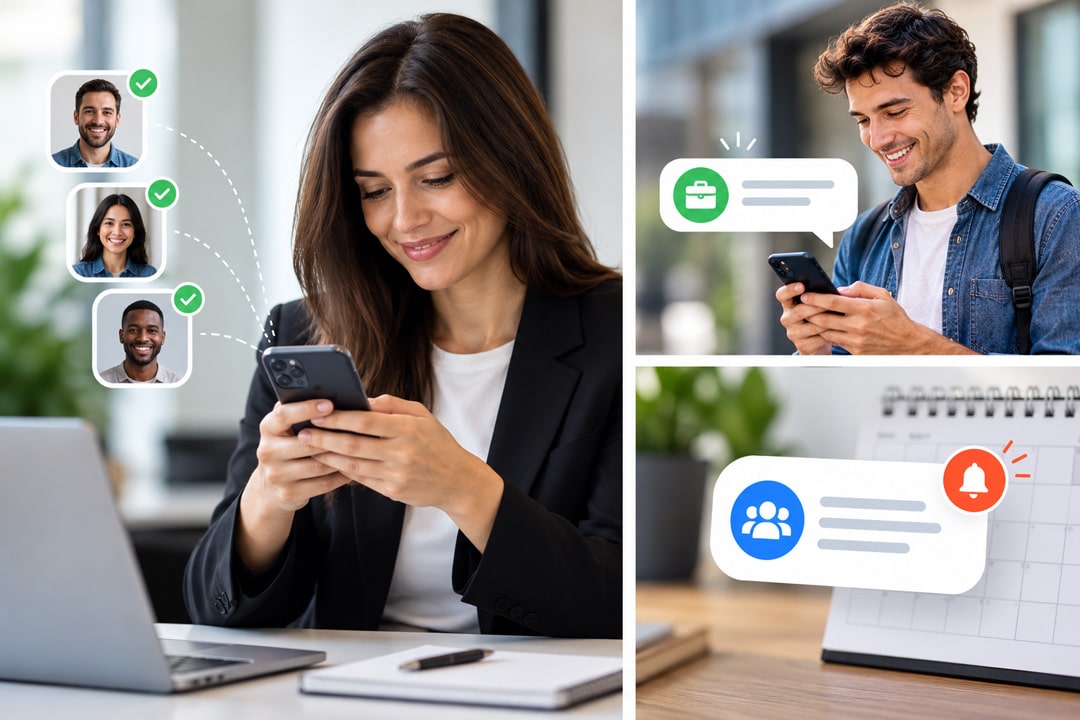
Group text messaging gives businesses a fast way to reach many subscribers with promotions, reminders, alerts, event updates, and customer information. However, manually sending every campaign at the exact moment it needs to go out can quickly become difficult.
Scheduling solves that problem.
With ProTexting, businesses can prepare group SMS or MMS campaigns in advance, select the right audience, choose the delivery date and time, and let the platform handle the send. As a result, marketing teams can organize campaigns around launches, events, appointments, seasonal promotions, and recurring customer communication without needing someone online for every message.
ProTexting’s group messaging workflow lets users create a campaign name, select one or more contact groups, and either send immediately or schedule the campaign for later.
For businesses that depend on timely communication, this simple workflow can make SMS marketing more organized, consistent, and scalable.
What Is a Scheduled Group Text Message Campaign?
A scheduled group text campaign is an SMS or MMS message prepared in advance and assigned to one or more subscriber groups for delivery at a future date and time.
Instead of logging into the platform right before a campaign should start, marketers can build the message earlier and schedule delivery.
Businesses Can Use Scheduled Group Texting for:
- Flash sales
- Product launches
- Appointment reminders
- Event announcements
- Store promotions
- Holiday campaigns
- Payment reminders
- Customer updates
- Internal employee communication
- Limited-time offers
For example, a restaurant might schedule a Friday lunch promotion on Thursday afternoon. Meanwhile, an event organizer could prepare reminders several days before an event.
As a result, teams can plan communication around business goals rather than relying on last-minute manual sends.
How to Schedule a Group Text With ProTexting
ProTexting keeps the process straightforward.
From a ProTexting account, users can go to Messages and select Send Group Text. Then, they can build the campaign and decide when it should reach subscribers.
The Basic Workflow Includes:
- Choose a campaign name.
- Select the group or groups that should receive the message.
- Write the SMS or prepare the MMS content.
- Choose between sending immediately and scheduling.
- Select the desired date and time.
- Review the campaign.
- Schedule it for delivery.
ProTexting notes that campaign names remain internal and do not appear to recipients. Therefore, marketers can use descriptive names such as “Labor Day VIP Offer” or “September Appointment Reminder” to make later reporting easier.

Use Clear Campaign Names
Campaign organization becomes increasingly important as SMS volume grows.
A business that sends only one campaign each month may easily remember what “Campaign 12” means. However, a retailer sending several promotions, reminders, and segmented campaigns each week needs a better naming system.
Consider Campaign Names Such as:
- Summer Sale – VIP – July 15
- Webinar Reminder – 24 Hours
- New Product Launch – Existing Buyers
- Downtown Store Event – Saturday
- Subscription Renewal – August
These names help teams understand the purpose, audience, and timing before opening the campaign.
Meaningful campaign names also make analytics easier to review later because ProTexting uses the campaign name internally for identification.
Organize Contacts Into Relevant Groups
Scheduling works best when businesses combine it with good audience segmentation.
Instead of sending every group text to every subscriber, marketers can organize contacts according to characteristics such as:
- Customer location
- Purchase history
- Product interest
- Loyalty status
- Event registration
- Customer type
- Engagement level
- Store location
- Subscription preferences
For example, a fitness company might maintain separate groups for yoga members, personal training customers, and class-pass users.
Therefore, a promotion for a new yoga workshop can reach the yoga group instead of the entire database.
This approach reduces irrelevant texts. It can also improve campaign performance because subscribers receive messages that better match their interests.
Schedule Messages Around Customer Timing
Scheduling SMS campaigns becomes especially useful when timing affects customer behavior.
For instance, a restaurant promotion may perform best shortly before lunch. Meanwhile, an event reminder should arrive close enough to the event that customers remember it.
Businesses Might Schedule:
| Campaign | Useful Timing |
|---|---|
| Lunch promotion | Late morning |
| Weekend sale | Thursday or Friday |
| Appointment reminder | One day before |
| Webinar reminder | Several hours before |
| Product launch | At launch time |
| Event update | Before attendees travel |
| Holiday offer | Before the shopping deadline |
However, businesses should consider local time zones and applicable quiet-hour requirements.
ProTexting’s group scheduling guide currently notes that scheduled messages use Eastern Standard Time. Therefore, marketers should account for the platform’s scheduling time when targeting customers in different regions.
Take Advantage of Recurring Scheduling
Some messages need to go out more than once.
For example, businesses may send monthly payment reminders, weekly class schedules, recurring event notices, or annual renewal messages.
Instead of rebuilding these campaigns repeatedly, ProTexting also offers recurring group scheduling. The platform supports repeated campaigns on schedules such as daily, weekly, monthly, or yearly intervals.
Recurring Scheduling Can Work Well for:
- Membership reminders
- Regular payment notices
- Weekly promotions
- Appointment programs
- Employee reminders
- Monthly customer updates
- Annual renewal notices
As a result, repetitive communication requires less manual work.
However, recurring campaigns still need regular review. Businesses should confirm the audience, message, links, and timing remain accurate before letting a campaign run indefinitely.
Use Drip Campaigns for Subscriber Journeys
Scheduled group texts work well when many people should receive the same message at the same time.
However, customer journeys often depend on when an individual subscriber joins.
For those situations, drip campaigns can provide a better solution.
ProTexting’s drip campaign functionality can automatically send a sequence of messages after a contact enters the program. Messages can follow one another after configured intervals such as minutes, hours, or days.
For Example, a New Subscriber Flow Might Look Like This:
Immediately: Send a welcome message and deliver the promised incentive.
Day 2: Introduce popular products or services.
Day 5: Share a helpful guide.
Day 10: Offer a limited promotion.
Therefore, group scheduling and drip campaigns solve different problems. Group scheduling follows a calendar, while drip messaging follows the individual subscriber’s journey.

Schedule SMS and MMS Campaigns
Not every campaign needs to rely on plain text.
ProTexting supports both SMS and MMS messaging, which allows businesses to incorporate richer content when appropriate. Its feature set includes sending and receiving photos, videos, and longer multimedia messages.
Businesses Might Use MMS for:
- Product launches
- Event promotions
- Menu announcements
- Real estate listings
- Fashion collections
- Visual coupons
- Seasonal campaigns
However, richer content should support the campaign goal. A simple appointment reminder usually does not need an image, while a new-product announcement may benefit from one.
Therefore, marketers should choose the format according to customer needs rather than using MMS simply because it is available.
Track What Happens After the Campaign Sends
Scheduling makes campaign execution easier, but marketers still need to measure performance.
ProTexting provides campaign analytics and delivery information. The platform also includes short URL and click-tracking capabilities that help businesses understand how recipients interact with links.
Useful Metrics Include:
- Messages sent
- Delivery status
- Link clicks
- Click-through rate
- Conversions
- Revenue
- Replies
- Opt-outs
For example, suppose a retailer schedules three different weekend promotions. Click tracking may show that product-specific messages outperform general sale announcements.
The retailer can then use that insight when scheduling future campaigns.
Plan Campaigns in Batches
One major advantage of scheduling involves workflow efficiency.
Instead of creating SMS campaigns daily, marketers can plan several campaigns in one working session.
A Monthly Planning Process Might Include:
- Review important dates.
- Select customer segments.
- Create campaign offers.
- Write the messages.
- Prepare landing pages.
- Schedule each group campaign.
- Review timing and links.
- Monitor results after sending.
This process creates more consistency. Moreover, it gives teams time to review messages before customers receive them.
However, businesses should still monitor scheduled campaigns. Inventory, pricing, event details, and customer circumstances can change. Therefore, marketers should update or cancel campaigns when the original message no longer applies.
Keep Scheduled Messages Relevant and Compliant
Scheduling makes SMS convenient, but it should not encourage excessive messaging.
Before scheduling a group campaign, confirm that:
- Recipients provided appropriate consent.
- The audience matches the message.
- The sender is clearly identifiable.
- Links work correctly.
- Offer conditions remain accurate.
- Timing respects customer expectations.
- Opt-out requests are honored.
- Multiple campaigns will not overlap unnecessarily.
Moreover, businesses should keep groups clean and remove customers who should no longer receive promotional messages.
Automation should make communication more useful, not make it easier to send irrelevant texts.

Make Group SMS Scheduling Part of Your Marketing Calendar
Scheduled group text messaging helps businesses coordinate promotions, reminders, launches, events, and customer communication without relying on last-minute manual work.
With ProTexting, marketers can organize subscribers into groups, create clearly named campaigns, choose between immediate and future delivery, use recurring schedules, and complement scheduled broadcasts with drip campaigns.
As a result, businesses can build a more structured SMS strategy while maintaining control over timing and audience selection.
Most importantly, scheduling should support relevance. The strongest campaigns reach the right subscribers with useful information at a moment when they can act on it.
By combining thoughtful planning, audience segmentation, scheduling, analytics, and proper consent management, businesses can use ProTexting to make group messaging easier while improving the overall customer experience.