Online shoppers abandon carts for many reasons. Some become distracted, while others hesitate over delivery costs, payment options, product compatibility, or return policies. However, an abandoned cart still represents strong purchase intent because the shopper selected a product and moved closer to checkout.
SMS abandoned cart messages give ecommerce businesses a timely way to reconnect with these potential customers. Unlike a general promotion, the message relates to an action the shopper recently took. Therefore, it can feel more relevant and helpful when the business uses suitable timing, clear language, and proper consent.
Nevertheless, successful cart recovery requires more than sending a discount code. Stores must understand why customers leave, build a sensible sequence, stop messages after a purchase, and measure the additional revenue that SMS actually creates.
What Is an SMS Abandoned Cart Message?
An abandoned cart SMS is an automated text sent after an eligible shopper adds products to a cart but leaves without completing the purchase.
The message may:
- Remind the shopper about the cart
- Link directly to the saved checkout
- Offer help with product questions
- Clarify shipping or return information
- Mention limited stock when accurate
- Provide an incentive when appropriate
Cart abandonment represents a useful buying signal because these shoppers have shown more intent than ordinary website visitors. Consequently, recovery campaigns can focus on people who already demonstrated interest instead of targeting a broad audience.
However, businesses should send these texts only to shoppers who provided the appropriate SMS marketing permission. Entering a phone number for delivery or account security does not automatically create consent for promotional cart reminders.
Understand Why Shoppers Abandon Carts
Before creating a message sequence, examine the reasons customers leave checkout. Otherwise, the campaign may repeatedly remind shoppers without addressing the actual problem.
Common causes include:
| Abandonment Reason | Helpful SMS Response |
|---|---|
| Unexpected shipping costs | Mention shipping terms or a valid free-shipping offer |
| Product uncertainty | Invite questions or link to product details |
| Payment concerns | Highlight available secure payment options |
| Delivery timing | Link to current delivery estimates |
| Distraction | Send a simple cart reminder |
| Price hesitation | Reinforce value before offering a discount |
| Technical problem | Provide support or a fresh checkout link |
For example, a customer who abandoned because of an unclear delivery date may not respond to “You forgot something.” However, the shopper may return when the message confirms that the order can arrive before a specific event.
Therefore, analyze checkout exits, support questions, customer surveys, and purchase data before finalizing the flow.
Send the First Reminder at the Right Time
The first message should arrive while the products and shopping experience remain fresh. Nevertheless, sending it immediately can feel intrusive because the customer may still be comparing products or planning to return independently.
A common approach is to wait between 30 minutes and a few hours. However, the ideal delay depends on the product, average buying cycle, and customer behavior.
Low-cost everyday items may justify a faster reminder. In contrast, furniture, electronics, luxury goods, and other considered purchases may require more time.
A useful first message could say:
“North & Pine: You left an item in your cart. Return to your saved checkout here: [link]. Reply STOP to opt out.”
This message identifies the store, explains the reason for contact, and provides one clear action.
Build a Short Cart Recovery Sequence
One reminder may recover some purchases, while a short sequence can address different barriers. However, businesses should avoid turning one abandoned cart into several days of pressure.
A simple sequence might include:
- First reminder: Send a helpful checkout link.
- Second message: Address common concerns or offer assistance.
- Final message: Add a genuine deadline or selective incentive.
For example:
- Message one: “Your cart is saved. Complete your order whenever you’re ready: [link].”
- Message two: “Questions about sizing or delivery? Reply to this text and our team can help.”
- Message three: “Your cart offer ends tonight. Complete checkout here: [link].”
Klaviyo recommends using quiet hours for abandoned-cart SMS flows and keeps that protection active by default. Therefore, businesses should delay messages that would otherwise arrive during unsuitable local hours.
Additionally, stop the flow immediately after the customer purchases. Receiving another cart reminder after paying creates confusion and makes the automation look unreliable.

Focus on Help Before Discounts
Discounts can increase conversions, but offering one too early creates several problems. Customers may learn to abandon carts intentionally, while full-price buyers may receive an unnecessary price reduction.
Instead, begin with convenience and reassurance. Remind the customer that the cart remains available, answer likely questions, and provide direct support.
Then, Use Incentives Selectively Based on:
- Cart value
- Customer history
- Profit margin
- Product category
- Subscriber engagement
- Previous discount use
- Likelihood of purchasing without an offer
For example, a first-time buyer with a high-value cart may respond to free shipping. Meanwhile, a loyal customer may need only a reminder.
Furthermore, calculate profit after subtracting the discount, messaging costs, product costs, and expected returns. More recovered revenue does not always mean more recovered profit.
Personalize the Message Without Overstepping
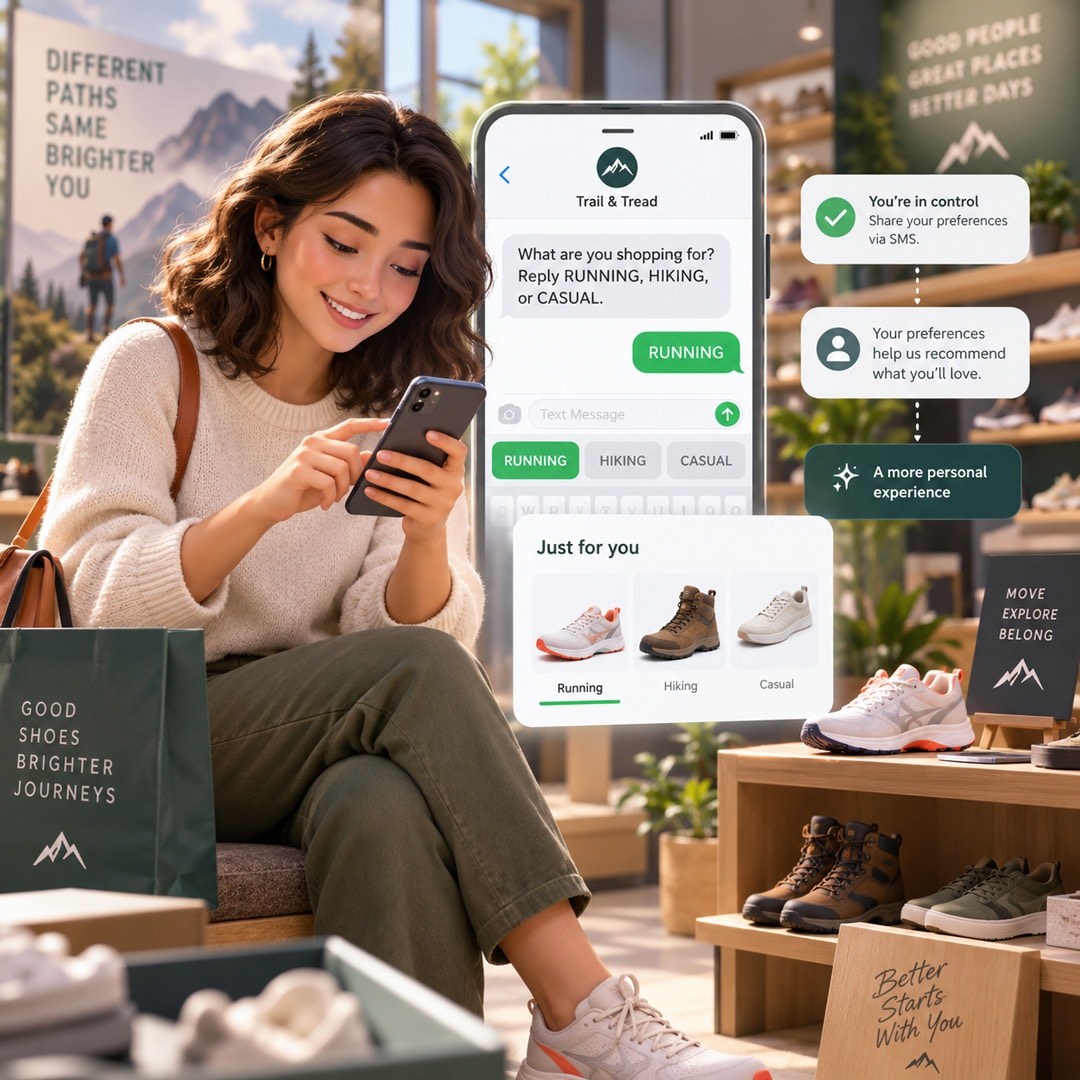
Relevant details can make the message more useful. For example, the store might mention the product category or show the saved item through an MMS or RCS experience.
However, avoid language that sounds like surveillance.
Helpful: “Still considering the navy travel bag? Your cart is saved here: [link].”
Uncomfortable: “We noticed you viewed the navy travel bag six times last night.”
The first message focuses on convenience. In contrast, the second one emphasizes tracking behavior.
Therefore, personalize around the shopper’s benefit rather than the amount of data the business collected.
Remove Friction From the Return Journey
Every abandoned cart text should link directly to a saved, mobile-friendly checkout. Sending shoppers to the homepage forces them to search for their products again and may erase the convenience SMS should provide.
Before launching the flow, test whether the link:
- Restores the correct cart
- Opens quickly on mobile devices
- Preserves selected sizes and quantities
- Applies valid discounts correctly
- Displays shipping costs clearly
- Supports the customer’s preferred payment methods
- Works after the original browsing session ends
Additionally, use a recognizable branded link when possible. Unfamiliar shortened URLs may look suspicious, especially because fraudulent texts often imitate ecommerce and delivery brands.
Coordinate SMS With Email
Email and SMS should support each other rather than send the same message simultaneously.
Email can display product images, reviews, recommendations, financing details, and return information. SMS, however, works better for concise reminders and immediate actions.
A coordinated sequence might look like this:
- Email after one hour with cart details
- SMS several hours later with a direct checkout link
- Email the next day with reviews or FAQs
- Final SMS only for highly engaged, consented shoppers
As a result, each channel performs a different role while the customer receives less repetition.
Measure Incremental Conversions
Basic reports may give SMS credit whenever a shopper clicks a text and purchases within a set window. However, some of those customers may have returned without the message.
Therefore, track both attributed and incremental results.
Useful metrics include:
- Delivery rate
- Click-through rate
- Checkout completion rate
- Revenue per recipient
- Gross profit per recipient
- Recovery rate
- Opt-out rate
- Discount usage
- Cost per recovered order
- Incremental conversion lift
Whenever possible, keep a randomly selected control group that does not receive the cart text. Then, compare its conversion rate with the group that receives the flow.
For example, if 8% of messaged shoppers purchase while 5% of the control group purchases, SMS may have created an estimated three-percentage-point lift.
Follow Consent and Opt-Out Rules
Abandoned cart texts often promote a purchase, so businesses should treat them as marketing messages and obtain appropriate permission before sending them. Furthermore, marketers must honor opt-out requests and maintain accurate suppression records.
FCC rules that took effect on April 11, 2025, strengthened consumers’ ability to revoke consent for covered robocalls and robotexts through reasonable methods.

Businesses Should Also:
- Identify the store clearly
- Explain the SMS program during sign-up
- Retain evidence of consent
- Respect quiet hours
- Provide clear opt-out instructions
- Avoid purchased contact lists
- Follow rules in every recipient’s jurisdiction
Ultimately, abandoned cart SMS works best when it removes friction rather than adds pressure. A timely reminder, direct checkout link, helpful answer, or carefully chosen incentive can give shoppers the confidence to complete their orders.
However, businesses should not judge success by recovered revenue alone. By protecting consent, coordinating channels, testing timing, and measuring incremental profit, ecommerce stores can turn SMS abandoned cart messages into a sustainable conversion strategy.