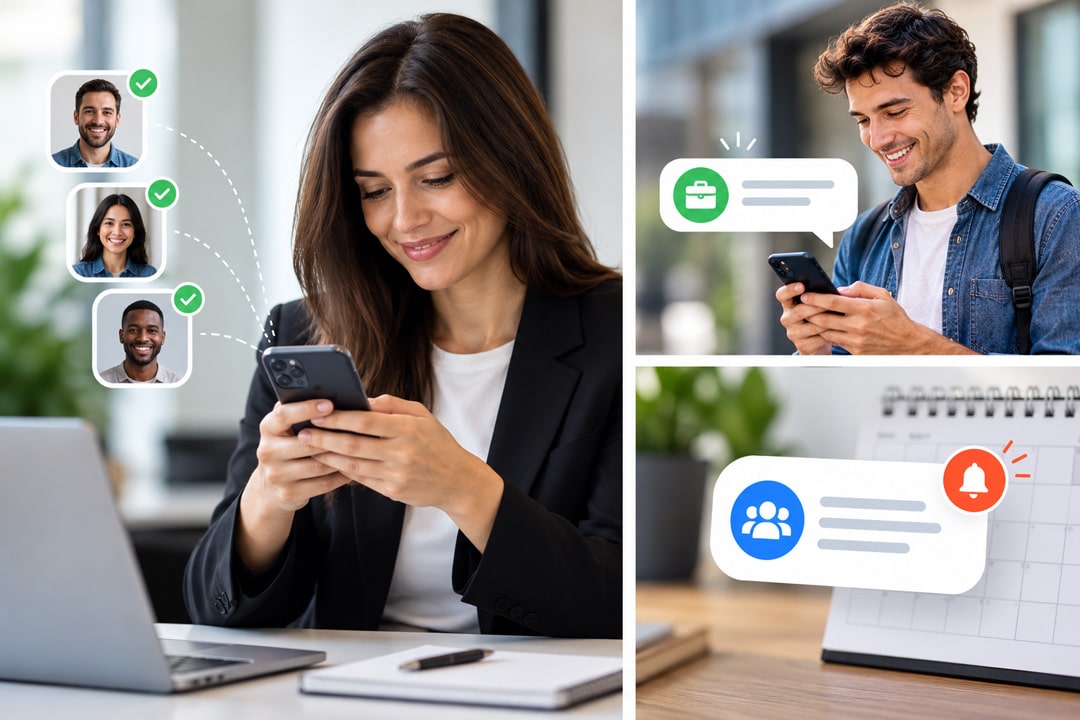
SMS marketing in 2027 will look less like traditional mass texting and more like coordinated, intelligent customer communication. Businesses will still use standard text messages because SMS offers broad device compatibility and does not require customers to install an app. However, artificial intelligence, richer messaging formats, tighter consent controls, and better customer data will reshape how brands plan campaigns.
Therefore, successful companies will not simply send more texts. Instead, they will use automation to choose the right message, channel, audience, and moment.
The strongest programs will combine SMS with RCS, email, customer service, and ecommerce data. As a result, mobile messaging will become more conversational, personalized, and closely connected to the complete customer journey.
SMS Will Remain the Reliable Foundation
Despite the rise of richer channels, SMS will remain important in 2027. It works across a wide range of mobile devices and does not depend on a specific app or advanced messaging support.
Businesses will continue using SMS for:
- Appointment reminders
- Delivery updates
- Security notifications
- Payment alerts
- Limited-time promotions
- Back-in-stock messages
- Customer support
- Emergency information
However, brands will become more selective about when they use it. Rising message costs, subscriber fatigue, and stricter filtering will make broad, poorly targeted campaigns less attractive.
Consequently, marketers will reserve SMS for messages that benefit from speed, visibility, and a simple next action.
RCS Will Create Richer Customer Experiences
Rich Communication Services will play a larger role in business messaging by 2027. RCS adds branded sender profiles, high-quality media, suggested replies, action buttons, product cards, and interactive conversations to the phone’s native messaging app.
For example, a retailer could send a product carousel with images, prices, and shopping buttons. Meanwhile, a hotel could display reservation details alongside options to check in, view directions, or contact support.
RCS May Support Experiences Such as:
| Customer Need | Possible RCS Experience |
|---|---|
| Product discovery | Scrollable product cards |
| Appointment booking | Tappable time options |
| Order tracking | Visual status updates |
| Event registration | Registration and calendar buttons |
| Customer service | Guided replies and rich instructions |
| Travel management | Booking details and check-in actions |
Nevertheless, RCS will not completely replace SMS. Device, carrier, platform, and customer settings will still affect availability. Therefore, businesses will need fallback logic that sends a clear SMS when a rich message cannot reach the recipient.

AI Will Manage More Than Message Writing
Many marketers currently use AI to draft promotional copy. By 2027, however, AI will influence almost every stage of SMS marketing.
AI systems may help businesses:
- Predict which customers will purchase
- Identify subscribers at risk of leaving
- Recommend products or offers
- Select an appropriate delivery time
- Detect changes in engagement
- Route incoming customer replies
- Summarize conversations for agents
- Identify unusual messaging activity
- Suggest the next best customer action
For example, a retailer may use AI to identify customers who regularly reorder a product after 45 days. The system could then send a replenishment reminder only when each shopper approaches the likely reorder date.
Therefore, personalization will depend less on inserting a first name and more on understanding customer intent.
Two-Way SMS Will Become More Important
Traditional SMS campaigns often send customers to a website. However, more brands will allow customers to complete simple tasks through the conversation itself.
Subscribers may reply to:
- Confirm an appointment
- Reschedule a booking
- Check an order
- Ask about product availability
- Skip a subscription delivery
- Choose message preferences
- Request customer support
- Accept or reject an offer
AI can classify these replies and send each customer to the correct workflow. Additionally, it can answer common questions using approved business information.
However, companies will still need human support. Billing disputes, complaints, unusual requests, and sensitive account problems should move quickly to trained employees.
As a result, the most effective SMS programs will combine automated speed with human judgment.
Personalization Will Become More Predictive
SMS personalization in 2027 will move beyond static segments such as age, location, or past purchases. Instead, businesses will use real-time behavior and predictive models to estimate what customers may need next.
For example, an e-commerce brand could consider:
- Recently viewed products
- Previous purchases
- Preferred price range
- Current inventory
- Loyalty status
- Recent support issues
- Message engagement
- Likelihood of conversion
The system could then decide whether to send a restock alert, educational tip, product recommendation, or no message at all.
Importantly, better personalization may result in fewer sends. If data suggests that a customer will purchase without another reminder, the platform may suppress the text.
Therefore, advanced SMS marketing will focus on incremental value rather than maximum campaign volume.
Consent and Preference Management Will Become Stricter
Privacy and consent will remain central to mobile messaging in 2027. Businesses will need reliable records showing when, where, and how each subscriber agreed to receive texts.
Moreover, companies will need to synchronize consent across messaging platforms, e-commerce systems, CRMs, and customer support tools. An opt-out recorded in one system should update every connected platform quickly.
Customers may also expect more detailed controls. Instead of choosing only between receiving texts and opting out completely, subscribers could select:
- Promotional or transactional messages
- Preferred product categories
- Local or online offers
- Message frequency
- Delivery reminders
- Loyalty updates
- Preferred language
Consequently, preference centers may help businesses retain subscribers who want fewer messages rather than no messages.
Brands Will Coordinate SMS With Other Channels
In 2027, businesses will stop treating SMS as an isolated marketing tool. Instead, customer journeys will move across SMS, RCS, email, apps, websites, and human support.
A coordinated abandoned-cart flow might look like this:
- Email displays the abandoned products.
- SMS offers a direct checkout link.
- RCS provides product images and reply buttons where supported.
- Customer support answers questions through the same conversation.
- The system stops all reminders after purchase.
This coordination will reduce repetition. Customers will not receive the same promotion through every channel at the same time.
Moreover, AI may select the most suitable channel based on urgency, customer preference, cost, and previous behavior.
Measurement Will Focus on Incremental Results
Last-click attribution will become less convincing as customer journeys become more complex. A shopper may discover a product through social media, read an email, search for reviews, and finally click an SMS link.
Therefore, marketers will increasingly use:
- Holdout groups
- Incrementality testing
- Multi-touch attribution
- Gross profit calculations
- Customer lifetime value
- Revenue per recipient
- Opt-out and complaint rates
- Cross-channel journey analysis
Businesses will ask whether SMS created an additional purchase, not merely whether it appeared before the transaction.
Furthermore, marketers will consider costs beyond the price of sending messages. Discounts, carrier fees, software, employee time, support, and customer acquisition expenses will influence ROI calculations.
Deliverability and Trust Will Matter More
Carrier filtering and fraud prevention will continue evolving. Therefore, verified sender identities, proper registration, accurate consent records, and consistent sending patterns will become even more important.
Businesses will need to avoid:
- Unfamiliar public link shorteners
- Misleading urgency
- Excessive capital letters
- Repetitive promotions
- Inaccurate sender information
- Sudden volume spikes
- Purchased contact lists
- Unsupported claims
Additionally, RCS verification and branded profiles may help customers distinguish legitimate businesses from fraudulent senders.
However, technology alone cannot create trust. Brands must also send useful messages and respect customer choices.
How Businesses Can Prepare for 2027
Companies do not need to rebuild their entire SMS strategy immediately. Instead, they can prepare through several practical steps:
- Audit consent and opt-out records.
- Connect SMS with CRM and ecommerce data.
- Introduce global frequency limits.
- Improve two-way reply handling.
- Test RCS with an SMS fallback.
- Use AI for one measurable workflow.
- Create a clear human escalation process.
- Measure incremental profit rather than attributed revenue alone.
Ultimately, SMS marketing in 2027 will become smarter, richer, and more conversational. However, SMS itself will remain valuable because of its simplicity and wide reach.
The businesses that succeed will not chase every new feature. Instead, they will combine reliable SMS, interactive RCS, responsible AI, clean customer data, and clear consent practices.
Therefore, the future of text marketing will not involve sending the most messages. It will involve making every customer interaction more relevant, useful, and easy to complete.